
Introduction
In a few short years, stablecoins have evolved from a niche part of the cryptocurrency world to a global payments tool. What we’re seeing now is a ride up the adoption curve, as new technologies make it easier than ever to implement stablecoin rails.
Stablecoins now represent nearly $500 billion in real economic payments, according to BCG analysis, growing at an estimated 55% annually. B2B payments in particular represent the lion’s share of that figure, reaching as high as $230 billion and growing even faster at 65% annually.
It’s easy to write off a “mere” $500 billion in economic activity against the $200 trillion global payments landscape. However, that would be a mistake; the business and fnancial worlds alike need what stablecoins can offer, and that value is clearly shown in the massive annual growth rates of stablecoins in business use cases.
The industry has also begun seeing large players make big moves, with record partnerships, acquisitions, and contracts signed in the past few years. Shifts like these demonstrate not just demand, but investor appetite to take the risk necessary to bring novel solutions to market. This has led to the proliferation of stablecoin-related offerings, buoyed by increasing regulatory clarity in the United States, Europe, Asia, and Canada, among other peer nations. Infrastructure builders like Cybrid have made it even easier to set up payment rails with full licensing, compliance, and tracking capabilities built in.
As the space grows, so too does the appetite for knowledge about its inner workings. Studies have been conducted on the economic activity of stablecoins or what individual stablecoin users are doing. What is missing is understanding of how businesses of all shapes and sizes perceive and leverage stablecoins for regular operations. In particular, a deep focus on cross-border transactions, a space where stablecoins have a clear use case and beneũt.
To help ũll this knowledge gap, we conducted a survey of over 450 executives and leaders across technology, product, c-suite, and payments in the US, Canada, and UK. Industries focused on SaaS, ecommerce, and fintech; annual revenues ranged from under $1 million to over $5 billion, while transaction volumes scaled from sub-$100 thousand to over $100 million monthly. We asked about their understanding of stablecoins, how international payments operate today, the value of stablecoins in a payments context, and perspectives on the future of payments.
As we all continue to learn and expand in this nascent space, our hope is this knowledge contributes to an increased sense of confdence and trust in the ecosystem.

1. Key data points
1.1 Understanding Stablecoin Users
58% of stablecoin users receive supplier payments via stablecoins, but only 46% send vendor payments via stablecoins. This suggests suppliers are pulling stablecoin adoption - not buyers pushing it.
Savings from using stablecoins
Stablecoin users report saving an average of 35% on cross-border payment costs. For the largest senders ($100M+/month), that climbs to 47%. Savings scale linearly with volume - companies moving more money see more savings.
71% of respondents say more regulatory clarity would increase their confidence in (further) using stablecoins. It outranks trusted infrastructure (55%) and integration with existing systems (44%) as the thing companies want before scaling their stablecoin use.
1.2 The Future of Stablecoin Use
Instant settlement priority
86% of all respondents rate real-time or near-instant settlement as "critical" or "very important" to the future of payments. Even a majority (60%) of Traditionalists agree.
Savings from using stablecoins
- Real time global payroll
- Instant supplier payments
- Reducing FX costs
- Regulatory and tax clarity
- Trusted infrastructure partners
- Integrations with existing systems
2. Setting the stage: Payments today
Businesses sending money abroad to pay individuals, vendors, suppliers, employees, or conducting intra-company transfers amounts to over $200 trillion annually, according to EXC Intelligence. This incomprehensible amount of money flowing each year generates over $600billion in fees for correspondent banks and other service providers in the cross-border payments space.
This section seeks to understand the "how*and "why" of that $200 trillion number.
2.1 Why businessestransact internationally
Businesses of all shapes and sizes in our survey responded that their top three use cases for international transactions were:
Rounding out the top five are customer payouts, for instance processing refunds, and investment or yield.
What are the primary use cases for cross-border money transfers in your company?
2.2 How businesses currently transact internationally
Next, we asked respondents to describe their "payment stack" in its entirety. The vast majority use both wires (75%) and traditional payment processors (79%) for international payments. Just over half (57%) report using stablecoins, a statistic we dive into more fully in the next section. Further, nearly half (44%) also use FX platforms as part of their payment stack, suggesting a clear need and use case for a dedicated international payments system. A healthy minority (20%) also report having used cryptocurrency at one point or another, reflecting its experimental nature but growing public awareness.
2.3 Settlement times in traditional finance

3. Stablecoin understanding and perspectives
We surveyed leaders in Finance, SaaS, and ecommerce. Naturally, we expected knowledge of stablecoins to be fairly high. However, we were still surprised at a few key findings around stablecoin awareness. Further, we noticed a pattern in the data that breaks down into different types of stablecoin users.That's what we're focusing on for this section.
That's what we're focusing on for this section.
3.1 Settlement times in traditional finance
The vast majority of respondents (78%) consider themselves very or extremely familiar with what a stablecoin is. Breakingdown this familiarity data point by domestic versus international, the data shows a slight discrepancy. While 83% of respondents from international businesses rated high familiarity with stablecoins, only 64% of respondents from domestic businesses rated the same.
Where things change is in stablecoin implementation: the utility of stablecoins, compliance requirements, and technical requirements.
3.2. The stablecoin wave
A majority (56.8%) of respondents said they were using stablecoins today. Diving into the data, we uncovered a deeper trend: Many businesses are using stablecoins, but use cases vary and volumes differ widely. The majority are either experimenting or are ripe for experimentation. A small minority were committed exclusively to traditional financial products like wires for international transactions.
Parsing out the segments, we discovered four unique archetypes.
An important caveat: No respondent indicatedtheir company is only using stablecoins (that is,no wires or bank transfers) or using stablecoinsfor a majority of their international transferactivity. This could illustrate the viewpoint thatstablecoins complement traditional rails, ratherthan replace them entirely.
3.3 Perceptions of risk and utility
Across all respondents, the plurality (40%) view stablecoins as emerging but promising and a slightly larger number (44%) view stablecoins as either practical in payments or core to future payments infrastructure.
Where the data gets interesting is breaking it down into different subsegments. Nearly two-thirds of Stablecoiners (62%) view stablecoins as practical in payments or core to payments in the future. Meanwhile, that number drops dramatically for Experimenters (31%), Future Experimenters(32%), and Traditionalists (20%).
Not all Stablecoiners hold rosy views, though; 12% view stablecoins as risky or experimental despite actively using them. Mean while 34% of Experimenters have the same view. A cut of the data between domestic and international use cases reveals one other line: 24% view stablecoins as experimental or risky, while only 15% of international business respondents felt the same.
4. Stablecoin use
Understanding different categories of stablecoin users is helpful to set the stage, but the real insight lies in how businesses use stablecoins and the benefits they receive. That's what this section is about.
4.1. Motivations and use cases for stablecoins
When people think about stablecoins, data suggest they tend to think about speed.
Across all respondents, the top two use cases - real time global payroll and instant supplier payments - revolve around speed. The third, reducing FX costs, is financial.
Interestingly, these three hold across Stablecoiners, Experimenters, and Future Experimenters. What changes is the order. Future Experimenters are the only segment where "Reducing FX costs" is the number one compelling use case (56%, beating payroll). Meanwhile, Stablecoiners have moved on to payroll as the key motivator.
The top motivationsfor using stablecoins:
FX costs
Noticeably absent is the value proposition of "Programmable payments / automation," which was the least compelling use case among all segments, despite it being a developer-favorite topic.
4.2. From motivations to use cases
The data demonstrate that respondents are following through on their motivations, with an interesting twist. While motivations tend to skew outward - the ability to pay people or reduce costs - two of the top three use cases reported in our survey are inward-bound.
The top motivationsfor using stablecoins:
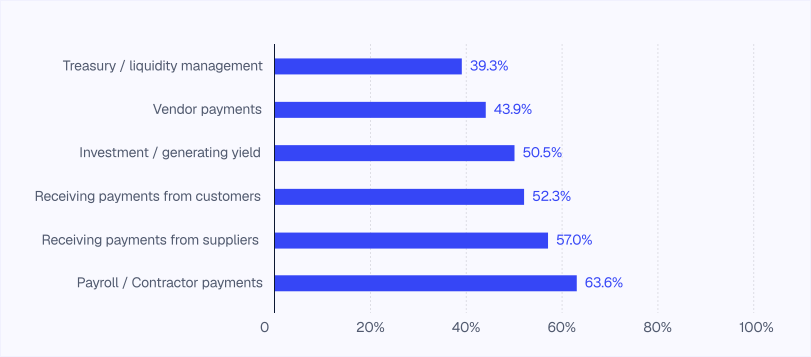
This opens the possibility that stablecoin adoption is less driven by companies looking to innovate on their own and more by customers. It speaks to an adage of always being willing to take a customer's money, however they want to pay.
4.3. Benefits of stablecoins
Respondents claimed a wide variety of benefits from their stablecoin use. Different data cuts reveal a peek behind the curtain of how organizations perceive benefit.
Both Stablecoiners and Experimenters claimed the same top five benefits. With a small margin, Experimenters said they received lower operational costs more frequently than they got lower payment costs; Stablecoiners were the opposite.
Leadership Priorities Diverge
Every role — CEO, CFO, CTO, and Other Executive Level — put faster settlement as the top benefit and named cost savings somewhere in their top five. However, they put it at different levels. For example, 50% of CEOs cited faster settlement as a key benefit, meanwhile 61% of CFOs said the same. CFOs also tended to focus on the financial side of things, ranking lower payment and ops costs as their second and third benefits, respectively. On the other hand, CEOs, CTOs, and other executives prioritized global market access above cost savings.
Where CEOs and CFOs aligned the most was transaction transparency, with nearly one third of CEOs (32%) and just over a third of CFOs (34%) saying it was a key benefit they get from using stablecoins. Meanwhile, no executives ranked decreased payment failures or improved yield as a top five benefit they currently receive.
Analyzing organizations by size - either revenue or volume of transactions - shows another angle to this. Smaller organizations, whether <$1 million annual revenue or <$100k monthly transaction volume, value new market access first and foremost. As organizations grow to the largest bands - over $50 million in annual revenue or $100 million monthly volume - value real time pavroll and reducing FX costs.
4.4. Cost savings
Cost savings came up consistently across both desired and reported benefits. Diving into respondent data further shows real potential for financial savings with stablecoins.
Overall savings
Among Stablecoiners, the average savings was 35% while Experimenters claimed 41.3%. This suggests that early savings might be overestimated or there are large initial savings that taper over time. It could also mean that experiments or trials are harder to measure precise cost ROl, so numbers might appear largert han they truly are. Regardless, it's still worth highlighting that an infrastructure switch from the traditional financial system to stablecoins netted savings over 30%, a dramatic reduction for a single shift that does not directly affect end-user experience.
Analyzing by role also reveals a perception difference. Focusing exclusively on Stablecoiners for this analysis, CEOs claimed an average savings of 51.4% while other leaders were far below that.
A likely explanation for this discrepancy is that different leaders have different purviews.
While a Treasury or Payment Operations Manager might only see the direct cost savings, a CEO has a holistic view of the organization and how one change has ripple effects. It's also possible that wider-purview roles like CEO and CFO are counting intangible savings, such as the value of a relationship that using stablecoins helped to secure.
Looking at domestic versus international Stablecoiners does not yield much difference. The two are almost identical - 31% average savings for domestic and 32% for international - suggesting that the economic upside of stablecoins is not exclusively for larger, international firms.
Savings by transaction volume
When it comes to savings rate, economies of scale come into play in a big way. For firms with over $100 million monthly transaction volume, average claimed savings are just over double that of organizations with less than $100,000 monthly transaction volume (47% vs 23%).
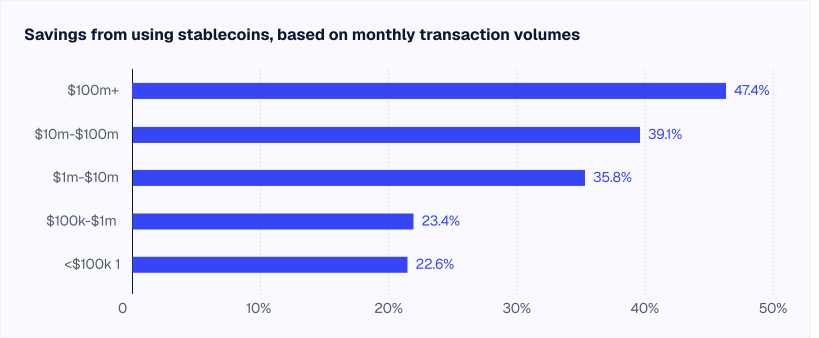
Savings also scale linearly; the higher your monthly transactions, the higher your claimed savings from using stablecoins
Savings by annual revenue
A similar pattern emerges when analyzing company revenue, though it's a little more choppy compared to an analysis by transaction volume.
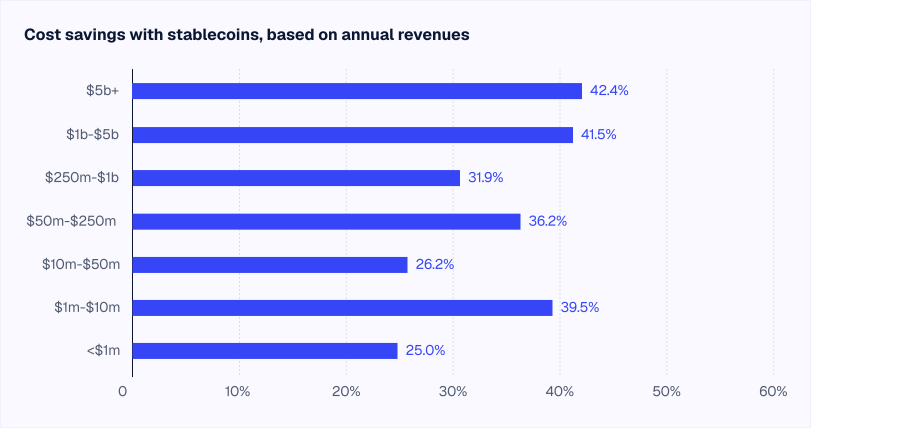
There is an interesting bump once a company hits $1 million in revenues; savings jump from 25% to 40%, but promptly drop back down once a company grows past $10 million revenue. This could be due to external factors. For example, companies over $1 million in revenue can make an investment in stablecoins that helps them move off of high-fee retail banking platforms. Meanwhile, complexities in business creep in by $10 million in revenue that take a while to sort out.
A similar bump-and-fall happens at $250 million in revenue, but again smooths out and grows to the highest claimed savings (42%) among companies with $5 billion or more in revenues.
Understanding savings claims
At first blush, it might seem like these savings are extraordinary. Saving up to 50% on a cost that can scale into the millions of dollars annually should, at least in theory, drive massive viral adoption. And to some extent, that's happening-B2B payments powered by stablecoins are growing at 65% CAR, as mentioned in the introduction to this report.
Yet stablecoins are not becoming a public sensation the way other technologies, particularly generative Al, have been. One possible explanation for this is simply that the media is preoccupied with Al and, as a result, doesn't have the bandwidth to explain a second, highly nuanced and complex technology like stablecoins. Another is that achieving savings with stablecoin infrastructure requires going through various compliance and legal hurdles that don't make for a thrilling viral story. A third possible explanation is simply fear and skepticism-even some stablecoin users report feeling skeptical about the technology, so that could be the reason why the viral adoption loop appears smaller than other breakthrough
4.5. Understanding Traditionalists and Future Experimenters
While the majority of this Report focuses on Stablecoiners and Experimenters, this mini section looks at why Traditionalists and Future Experimenters are not eager to use stablecoins. Among those two groups, the most common barriers were a lack of internal knowledge (52%) and regulatory concerns (51%).
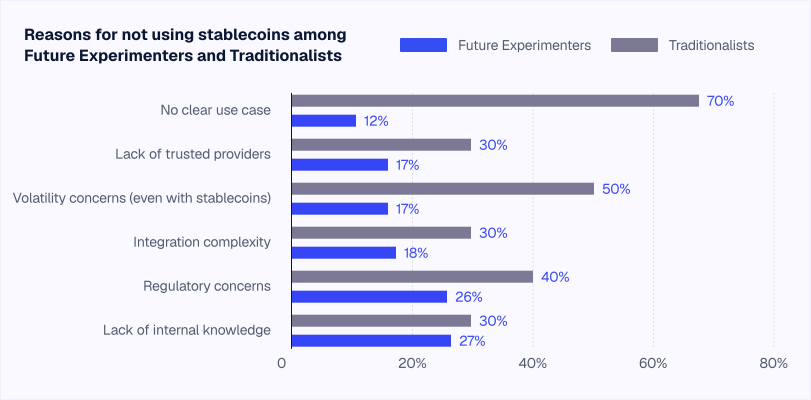
For Future Experimenters, the biggest barriers are lack of internal knowledge and regulatory concerns. Meanwhile, volatility concerns in stablecoin markets and not seeing a clear use case dominates for Traditionalists.
Interestingly, both groups did not feel that integration complexity or lack of trusted providers was the core barrier to growth. This suggests broader concern or fear of the stablecoin market itself, not a belief that providers cannot deliver.
5. The future of stablecoins and payments
As savings and benefits come more into focus, there are questions about the future of stablecoin use. That's what this section focuses on.
5.1. Starting, stopping, and continuing using stablecoins
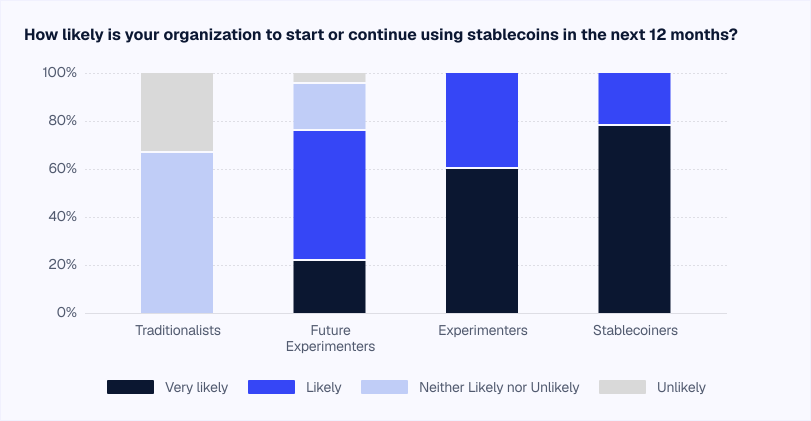
Across all respondents, sentiment is broadly positive. However, optimism tends to follow existing usage patterns. Effectively all Stablecoiners, for example, say they are very likely or likely to continue using stablecoins in the next 12 months. By contrast, 80% of Traditionalists say it's unlikely or very unlikely that they will use stablecoins in the next year.
5.2. Understanding Traditionalists and Future Experimenters
The next question we asked was around confidence - specifically, what would increase an organization's confidence to either start using stablecoins or focus on scaling their use case. Across all respondents, the biggest answer by far was regulatory clarity (71%). The top three ounded out with trusted infrastructure (55%) and integration with existing systems (44%).
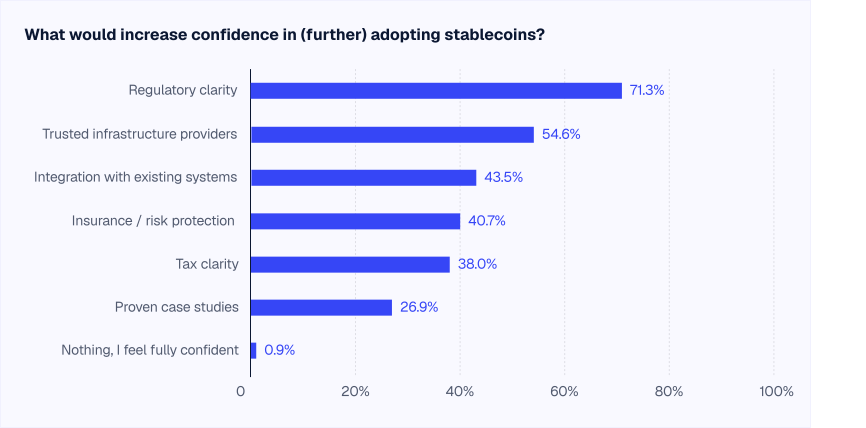
Diving into each persona reveals a deeper piece of the story, with an interesting duality. Traditionalists and Experimenters have nearly the same top three, meanwhile Future Experimenters and Stablecoiners do as well. The exact percentages are different, but the story is similar — across the board, companies want external clarity before moving forward with major investments.
2. Regulatory clarity.
3. Integration with existing systems
2. Proven case studies
3. Tax clarity
2. Regulatory clarity
3. Integration with existing systems
2. Tax clarity
3. Insurance / risk protections
Understanding by role, revenue, and volume
For CEOs and CFOs, regulatory clarity is the top driving force (57% and 49%, respectively). Meanwhile, COs and Treasury teams value trusted infrastructure providers first (54% and 51%, respectively) before regulatory or tax clarity.
Trusted infrastructure providers is also a critical element for companies doing over $100 million a month in international transactions; 64% say it's the first priority. Only at smaller volumes does egulatory and tax clarity matter most (59% for sub-$100k monthly volumes). Looking at revenue levels tells a similar story to transaction volumes.
The trend across the board becomes fairly clear that as companies scale, they value the right partner to help them scale further. When companies are small, they want legal clarity so they can move quickly.
5.3. The future of payments
Respondents broadly view payments as a rapidly changing space. For instance, 59% of Stablecoiners and 49% of Experimenters think that payments will either be fully reimagined or significantly transformed by automation in the next 12 months. A smaller percentage of Future Experimenters (34%) believe the same while the majority of this segment (55%) believe the space will be marked by incremental improvements rather than significant changes.
In contrast, the majority (60%) of Traditionalists believe that payments will be mostly unchanged in 2026 and 2027, the only segment with over 15% of respondents believing thes pace won't change.
This poses an interesting question: Are Traditionalists skeptical of payments evolution because they don't like stablecoins, or do they not like stablecoins because they are skeptical of payments evolution? This needs to be further explored, as the answer could illustrate what might be necessary to turn Traditionalists - of which there are likely many more in the real world than represented in this report - into Future Experimenters.
the only segment with over 15% of respondents believing thes pace won't change.
The speed of payments
While there are differing opinions on how much payments will evolve in the next 12 months, all groups agree on the importance of real-time or near-instant payments in the future.
The large majority (86%) believe near-instant or real-time settlement is either very important or critical to the future of payments, giving innovators a clear direction and following the overall trend of technology compressing timelines.
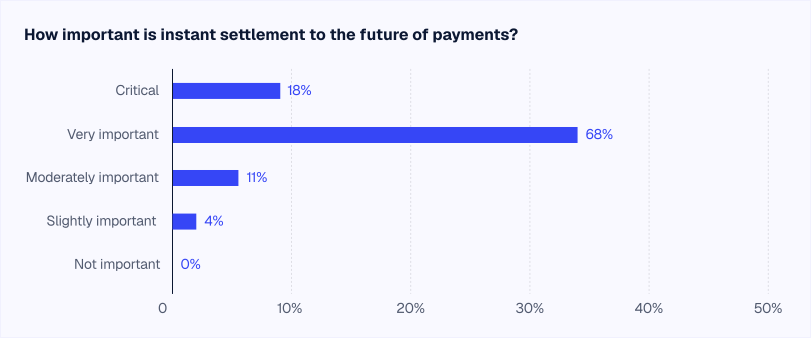
Even 60% of Traditionalists believe instant or near-instant settlement is either very important or critical, underscoring how important this payments innovation truly is.
Conclusion
The world is watching what happens next with stablecoins. At a rapid annual growth rate with applicability to multiple business use cases, there is a lot of excitement about the potential of this technology.
That said, barriers remain. Companies want to feel more secure in regulation, tax rules, and knowing they have a trusted provider to help them launch and scale.
Looking ahead, there is reason for optimism. The vast majority of companies are at least open to the concept of stablecoin technologies, creating an open space for builders within the stablecoin ecosystem.
Methodology and demographics
This report is based on a survey of over 468 executives and business leaders conducted by Cybrid between April 28th, 2026 and May 4th, 2026. Respondents were drawn from across technology/SaaS, financial services/fintech, and ecommerce sectors, and included C-suite executives (CEO, CFO, CTO, CPO), finance and treasury managers, and operations and payments leaders.
The survey sample included both domestic-only businesses and organizations operating internationally across multiple geographies and countries. Respondents were segmented by annual revenue (from less than $1M to more than $5B), monthly cross-border transaction volume (from less than $100K to more than $100M), number of countries transacted with (domestic only, 2-3 countries, and 4+ countries), and primary business function.
Data in this report reflects responses across all segments unless otherwise noted. Certain charts and comparisons reflect filtered cohorts - Stablecoiners, Experimenters, Future Experimenters, and Traditionalists — as defined in the Stablecoin Understanding section.
Report published: June 30, 2026
Report authors and reviewers:

