The US-to-India Remittance Corridor in 2026: Why the World's Largest Route Runs on Stablecoins
.png)
Traditional banking doesn’t work for India’s needs; stablecoins do
Key takeaways:
- India pulled in a record $135 billion in remittances in 2025 (with the US as its largest contributor) alongside $47 billion in FDI. Despite US-India being the world's largest remittance corridor, traditional correspondent banking rails remain slow, expensive, and opaque due to intermediate bank chains, timezone gaps, and secondary currency treatment of INR.
- Stablecoins have become the default settlement rail because they address the three biggest traditional complaints: settlement speed (moving actual value in minutes vs. SWIFT messaging taking days), end-to-end traceability, and local demand dynamics.
- Local payout partners in India face massive demand for US dollar liquidity, using received stablecoins (like USDT/USDC) for dollar-denominated purchases or reselling them locally at premiums up to 8% or more, making stablecoin settlement highly lucrative for platforms operating in the corridor.
—
India pulled in a record $135 billion in remittances in 2025, more than any other country in the world. The single largest source of those remittances? Americans. The same US-India corridor also carries roughly $47 billion in FDI from global businesses building in India.
Volume like that usually comes with mature traditional banking behind it. Dense corridors moving this kind of money tend to attract enough competition that spreads compress and settlement gets boring. That hasn't happened here. Instead, Indian remittance and business payments platforms have had to look elsewhere, which led to incredible innovation in stablecoin-based settlement.
This post covers how India became the largest remittance market on earth, why the traditional banking rails never caught up to that volume, and why stablecoins have become the default way money actually moves between the two countries.
How India became the world’s largest remittance corridor
Millions of Indians live and work in the US, the UK, the Gulf, and beyond, and sending money home isn't optional for most of them. Instead, it’s a cultural or familial obligation.
A common version of the story: a family invests heavily in one child's education, that child moves abroad for work, and remittances become the return on that investment for years afterward. Multiply that by a diaspora in the tens of millions and you get a corridor this size.
Tax treatment reinforces the pattern. NRE accounts, held in rupees, come with favorable tax treatment for non-resident Indians, and NRO accounts offer a different but still workable structure for Indians living abroad to minimize taxes and streamline finances at home and abroad. Both push more of the flow through formal, plannable channels instead of one-off transfers.
None of that explains why the money increasingly moves as stablecoins instead of plain wires. For that, you have to look at who's actually sending it, and where it lands once it does.
Remittances to India by country
The US isn't just a large contributor to India's remittance total. It's the largest, by a wide margin, according to the Reserve Bank of India’s own bank-channel data.
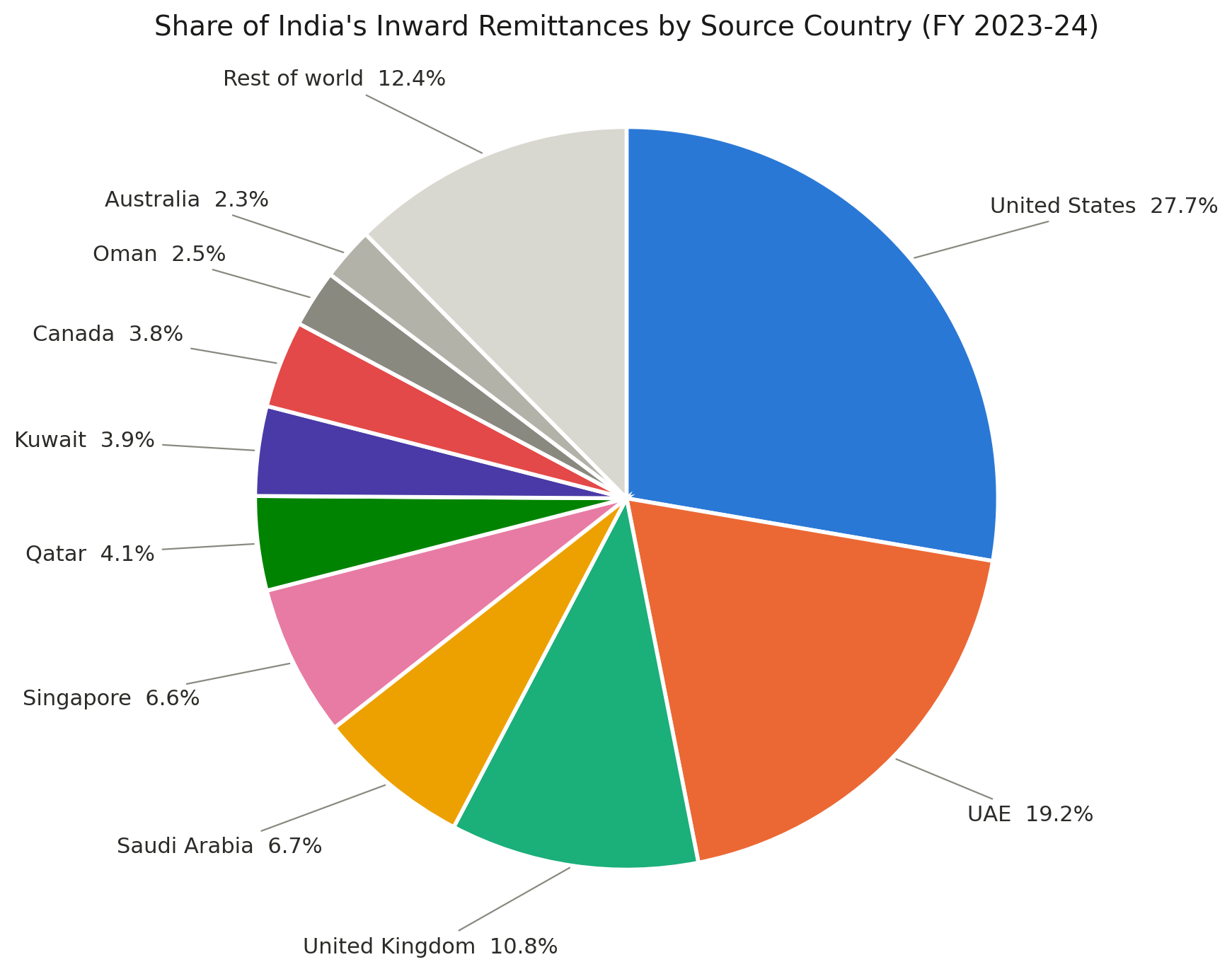
Everything downstream in this post is really about one specific pair: US dollars becoming Indian rupees, at scale, for millions of families every month. You'd expect a pair moving this much money between two of the largest economies in the world to run on cheap, fast, thoroughly modern banking rails. It doesn't.
The failure of traditional banking rails for the US-India corridor
Correspondent banking wasn't built for this pair at this volume. USD-INR isn't a G7-to-G7 relationship with a dense web of direct banking ties; a dollar moving into rupees often passes through more intermediate banks than a payment between, for instance, the US and the UK.
Every additional bank in that chain takes a cut and adds a delay, the same problem all traditional international payments face, only multiplied.
Outside the G7 majors, INR is treated as a secondary currency, and the liquidity, hedging, and settlement infrastructure built around it are thinner than for currencies banks trade constantly. Then there's plain geography. Even where solid partner-bank relationships exist, the distance and time-zone gap between the US and India adds real settlement lag on top of whatever the correspondent chain already costs.
Every one of those frictions shows up to the person actually sending or receiving the money as the same three complaints: it's slow, you can't see where it is, and by the time it lands, you're not sure it arrived at the rate you expected. Stablecoins address exactly those three complaints, which is a large part of why this corridor moved toward them faster than almost anywhere else.
Why the US-India remittance corridor runs on stablecoins
Cybrid has made this argument before: remittance was the first real place regulated stablecoins proved they could handle serious volume, not just speculative trading. The US-India corridor is where that proof shows up most clearly today, for three specific reasons.
Demands for speed
When someone sends money home, they want it to land now, not in two or three business days. Sometimes it's an emergency. More often it's the expectation that a platform you trust doesn't leave your money sitting in transit.
The key proposition of stablecoins is that the actual value—fungible, redeemable value—can move digitally. Contrast this to SWIFT, which is a messaging system that indicates value will eventually arrive. Meanwhile, banks have to manage actual settlement over days. With stablecoins, the unit of value and the confirmation move together, so a transfer that used to take days settles in minutes.
Demands for traceability
Traceability matters especially in B2B payments, but it applies to remittance too. Senders and recipients want to know exactly where their money sits at any given moment.
Correspondent banking is opaque. Once a payment enters the chain, tracking it down means calling around and waiting. A nicer app layered on top of that chain doesn't fix the opacity underneath. Moving the value itself onto a traceable rail does, which is how stablecoins fix this problem.
The USDT premium in India
Demand for dollar-denominated value inside India outstrips what official channels supply, even with $135 billion a year already moving through the country. Payout partners on the receiving end take USDT or USDC, hand out rupees at the going rate, and keep the stablecoin for themselves. Some of it goes toward their own dollar-denominated purchasing, since foreign vendors often give better terms to a buyer paying in dollars, and the rest gets sold on at whatever premium the market will bear—often up to 8% or more.
None of this is unique to India. It's just where the pattern shows up most forcefully, given the combination of factors around INR currency strength, the Indian banking system, and demand for US dollars.
Building for the US-India corridor
If you're building for India, whether you're expanding an existing product into the corridor or starting a new one from scratch, the cultural mechanics matter as much as the technical ones: family obligation, NRE/NRO tax treatment, the specific reasons dollars trade at a premium once they land.
What you need is infrastructure flexible enough to meet those demands as they shift: licensing, compliance, banking connectivity, FX, and settlement, wired into a stack you don't have to rebuild every time an enforcement action or a regulation moves the ground under the corridor.
That's the layer Cybrid provides for teams building on the cross-border and remittance corridor: licenses, compliance, banking connectivity, FX, and settlement, without standing inside the payment flow itself.
Book a demo with Cybrid to talk through what you’re building and see how we can help bring costs down and improve transaction reliability.
Ready to move your business onto stablecoin rails?

Where technology meets money movement